
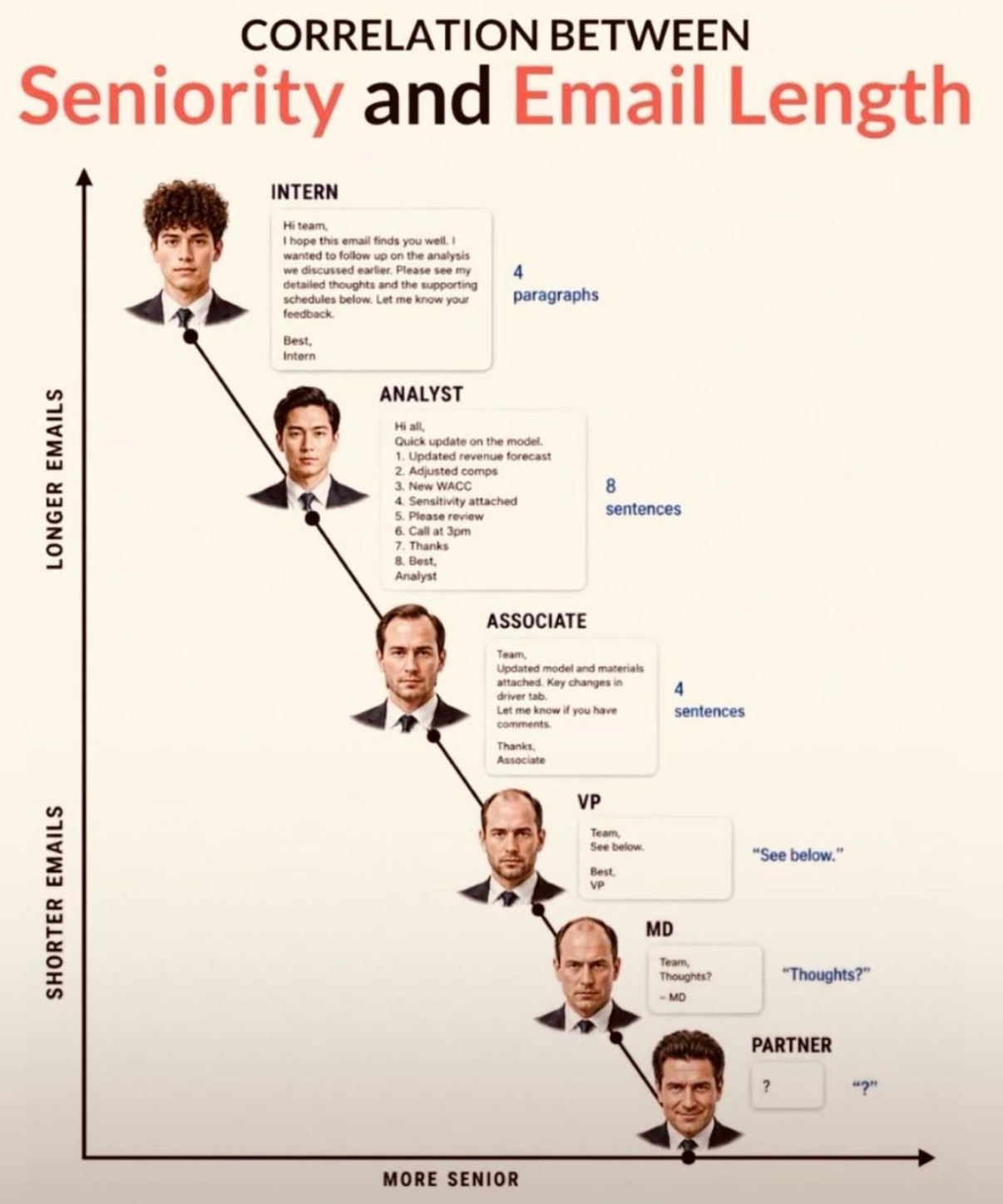
In banking, the more senior you are, the shorter your emails get. It is a running joke on every deal team, and it is also a fairly precise description of how the job changes, and of what juniors get wrong when they try to skip ahead.
Every banker knows the pattern. The summer intern sends four careful paragraphs. The partner replies with a single question mark. Somewhere in between, the analyst discovers numbered lists, the VP discovers “See below,” and the MD discovers that “Thoughts?” can carry an entire opinion.
It is funny because it is true. It is worth taking seriously because email length is not really about writing style. It tracks what each level is paid to do: produce the work, check it, route it or decide on it. The words shrink as the job moves from making things to judging them.
Short Emails Are a Privilege of Context
The partner’s question mark is not rude. It is efficient, and it only works because of everything around it.
Senior bankers write short emails for three reasons. First, they hold the context. A partner who has covered a client for fifteen years does not need to explain why the board meeting moved. Everyone on the thread already knows, or is expected to find out by morning. Second, they read and write on a phone, somewhere between a client dinner and a 7 a.m. flight. Third, and most important, their job is no longer to produce the work. It is to approve it, redirect it or ask the one question nobody else thought of. A decision rarely needs more than a few words.
The research agrees, a little uncomfortably. David Owens, then at Vanderbilt’s Owen Graduate School of Management, found that people with high status in organizations tended to send email with the worst spelling and grammar. Lower-status employees, trying to impress the people above them, sent carefully composed messages and were more likely to add emoticons and exclamation points, which Owens said can signal submission (Vanderbilt Magazine). Polish, in other words, flows uphill.
The data on what gets answered points the same way. When the email service Boomerang analyzed some 40 million messages, response rates peaked for emails of 50 to 125 words, topping 50% (Fortune). The same study found that emails of ten words or fewer got a reply only about a third of the time (HubSpot). That is the catch for anyone tempted to imitate the partner: a two-word email gets answered when the sender is senior enough that ignoring it is not an option.
What Each Level Is Really Writing
Interns and analysts are writing to prove the work exists. A junior banker’s long email is usually an act of good faith. They have plenty of context and no sense yet of which parts matter, so they include all of it, often in a tidy numbered list. The instinct to be thorough is right. The skill still missing is editing: knowing which of the eight points the reader actually needs. Most interns learn it the first time a VP asks a question that their own first paragraph already answered.
Associates are writing to hand work over cleanly. By now the attachment is the message and the email is its cover letter: what changed, where to look, what is needed back. Associates still sign off with “Thanks,” because they still have someone to answer to. They are also the first real filter, cutting the analyst’s version down before it travels any further up.
VPs are writing to route work. A VP’s short email is traffic control: work goes down, questions go up, and anything not ready stays away from the MD. “See below” means this is now yours. It is delegation, compressed.
MDs and partners are writing to decide. At the top, the job is approving, redirecting or asking the one question nobody else thought to ask, and that rarely takes more than a few words. A one-word reply is not the absence of an opinion. It is usually a test. The senior banker already has a view and wants to see whether yours lands in the same place.
The Trap: Writing Above Your Level
Brevity is a result of seniority, not a shortcut to it. The most common mistake we see in junior bankers, and now and then in lateral candidates, is borrowing the partner’s brevity without the partner’s authority.
An analyst who emails an MD “Thoughts?” has not been efficient. They have handed the MD the job of working out what the analyst wants. Short emails work at the top because the sender can afford to be misunderstood: someone below them will do the decoding. Junior bankers have no such cushion. When their emails are unclear, the cost lands on them.
The best juniors write short at the top and complete underneath. The first line carries the answer or the ask. The detail sits below for anyone who wants it. A useful test: could the MD forward your first two lines to the client without editing them? Something like this:
Revised comps attached. The EV/EBITDA range moves to 9.5x to 11.0x after we removed two peers with pending deals; detail below. Need your sign-off by 4pm to make the board book.
That is three sentences, with the number, the reason, the ask and the deadline. It reads as if an associate wrote it, which is the point. Seniors are watching for the junior who already writes like the next level up.
What AI Changes
There is a newer wrinkle. AI tools now draft emails as easily as they draft comps. When four polished paragraphs cost nothing to produce, length no longer signals effort, and senior readers discount it even faster than before.
We wrote recently about how junior bankers will increasingly be judged on judgment rather than production (Judging Judgment). Email is where that shows first. A long, fluent message that buries the ask now reads less like diligence and more like unedited output.
So the skill seniority rewards, knowing what to leave out, becomes more valuable. A machine can make any email longer. Deciding what the partner actually needs to read is still a human job, and it is one of the clearest signs a banker is ready for the next seat.
What It Means for Your Career
- Put the answer in the first line. Detail goes below the ask, never above it.
- Size the email to the decision, not the effort. The reader does not need to know it took until 2 a.m. They need to know what to approve.
- Do not borrow senior style before you have senior context. From a partner, “?” is a question. From an analyst, it is a problem.
- Learn to decode short emails. When you get “Thoughts?”, reply with a view, a reason and a recommendation, in that order, in a few lines.
- Watch your own emails get shorter. It usually means people have started trusting you with less explanation. That is often the earliest promotion signal you will get, well before year-end reviews.
The joke lands because everyone in banking has lived it. The lesson underneath is that each level is paid to do something different, and the best bankers write for the job they have, then the one they want. And if a partner ever answers your four paragraphs with a single question mark, take some comfort. At least they opened it.
Related reading
- Judging Judgment: How Junior Bankers Learn, and Get Evaluated, When AI Drafts the Work
- Chairs, Vice Chairs and Rainmakers: How Banks Use Senior Titles, and What It Means for the MDs Below Them
Sources
- Featured image: “Correlation Between Seniority and Email Length,” circulating on LinkedIn, October 2026; original creator unknown
- Vanderbilt Magazine, Fall 2001: “What Your E-mail Says About You” (research by David Owens, Owen Graduate School of Management)
- Fortune: Here’s Why Your Coworkers Are Ignoring Your Emails (Mar. 2, 2016; Boomerang study of 40 million emails)
- HubSpot: What is the ideal length of a sales email? (Boomerang data on very short emails)