
Johnson Associates expects Wall Street bonuses to rise for a third straight year, led by equity and deal bankers. Here is what the forecast, third-quarter pay accruals and the bonus calendar mean if you are thinking about a move.
Wall Street bonuses are set to rise for a third straight year in 2026, and equity and deal bankers will see the biggest gains. That is the headline from Johnson Associates’ latest pay forecast, released November 10 and reported by Reuters.
The compensation consultancy expects incentive pay for equity sales, trading and IPO underwriting to climb 20% to 30% in 2026. M&A advisory bankers should see 15% to 20% more. Founder Alan Johnson expects 2026 to end as “the year of the banks.”
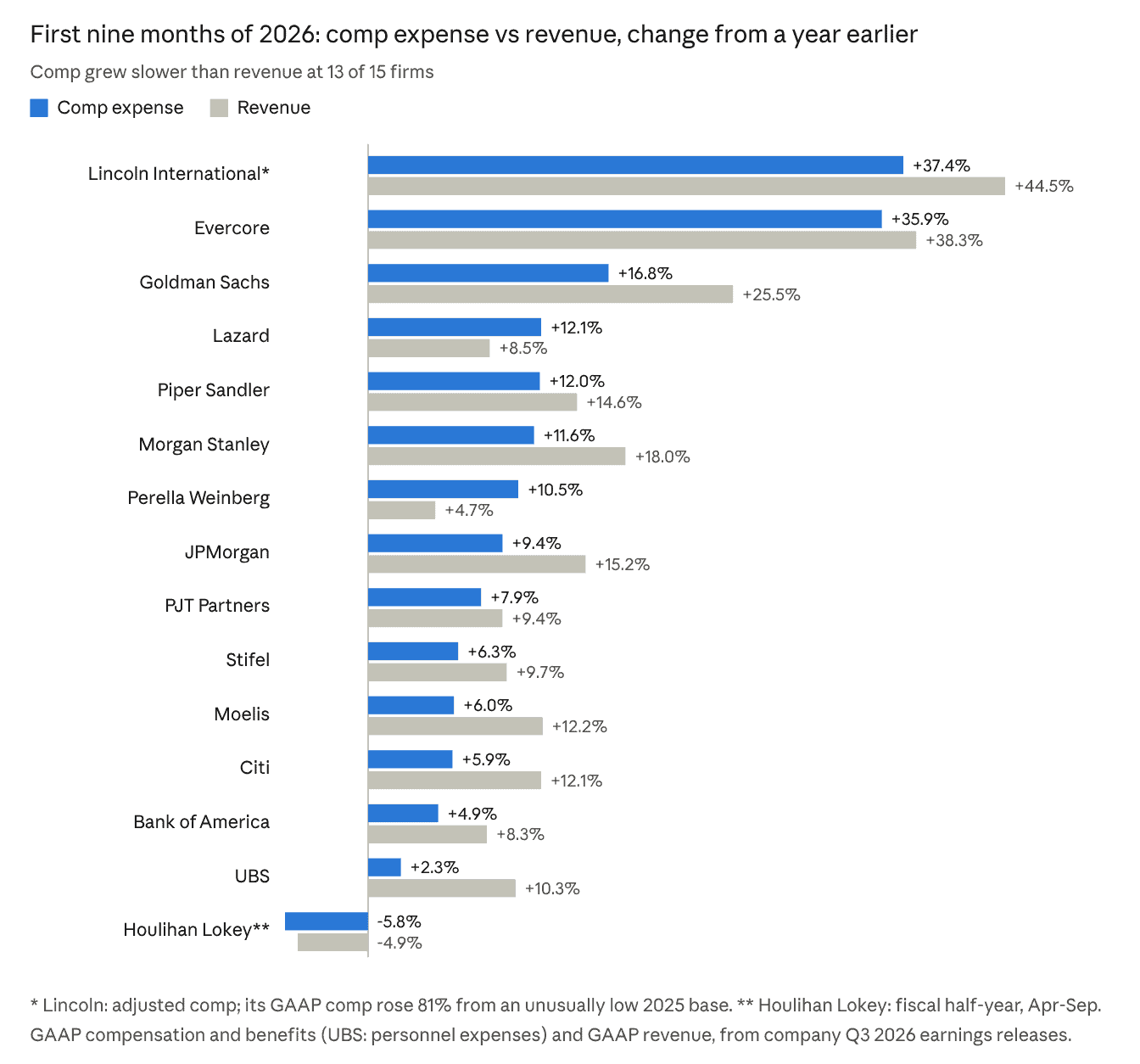
The forecast lines up with what banks have already set aside. Through the first nine months of 2026, comp expense is up 5% to 17% at the big U.S. banks and more than 35% at Evercore and Lincoln International. At most firms, though, pay is growing slower than revenue. Below, we pull together Johnson’s numbers, the year-to-date data, the changes in how banks pay, and what it all means if you are thinking about a move. Year-end numbers are weeks away, and they shape every lateral conversation that follows.
Johnson’s 2026 bonus forecast by business line
Equities and ECM lead the forecast, and private credit is the only area where Johnson expects pay to fall.
| Business line | Expected 2026 incentive pay change |
|---|---|
| Equity sales, trading and IPO underwriting | Up 20% to 30% |
| M&A advisory | Up 15% to 20% |
| Fixed income sales and trading | Up 7.5% to 12.5% |
| Insurance and asset management | Flat to slightly higher |
| Private credit | Down (no figure given) |
Source: Johnson Associates, via Reuters, November 10, 2026.
The ranking matches where the fees came from. Worldwide investment banking fees reached $99.4 billion in the first nine months of 2026, up 9% from a year earlier and the highest since LSEG records began in 2021. Johnson also flagged a slowdown: higher rates and market volatility are starting to cool this year’s record dealmaking and trading.
Three years up: how 2026 compares
This is the third rise in a row, and 2026 is on track to beat 2025. New York State Comptroller Thomas DiNapoli expects the 2026 bonus pool to rise, barring a major economic shock:
- Securities industry profits jumped 51.3% to $45.9 billion in the first half of 2026 and are on pace to top $90 billion for the year.
- Firms spent 18.8% more on salaries, bonuses and stock pay in the first half than a year earlier.
- For reference, the 2025 New York City bonus pool was $49.2 billion, with an average bonus of $246,900 (up 6%) and average total pay of $561,770.
Our own data shows the recovery already under way. In the Prospect Rock Partners 2025 IB Compensation Report, based on 866 responses, 79% of bankers were paid a higher 2025 bonus than in 2024, and nearly half saw gains of 20% or more. Only 8% saw a decline.
The gap was at the top. Senior MDs (4+ years) had the weakest recovery: just 47% were paid more, and over 20% were paid less. Group heads did best, up 57% over three years to $1.75 million. If Johnson is right, 2026 is the year the rest of the senior ranks catch up, especially in ECM and M&A.
What year-to-date accruals say about the bonus pool
Banks book bonuses through the year, so comp expense for the first nine months is the best early read on the pool. A single quarter can mislead: Perella Weinberg’s Q3 comp rose 50% and Lincoln’s GAAP comp rose 94%, but both compare with unusually weak quarters a year earlier. Year to date, pay is up at 14 of the 15 firms below, and it is growing slower than revenue at 13 of them.
A few things stand out:
- Pools are bigger in dollars, even where ratios fall. Goldman’s comp is up 16.8% on 25.5% more revenue, cutting its comp-to-revenue ratio to about 29.6% from 31.8%. Morgan Stanley’s ratio fell to 40% from 42%. A lower ratio on higher revenue still means a bigger pool.
- Evercore and Lincoln lead. Evercore’s comp is up 36% on 38% more revenue, and its adjusted comp ratio fell to 63.5% from 65.3%. Lincoln’s adjusted comp is up 37% on 45% more revenue, and it hired 10 MDs in the first nine months.
- Lazard and Perella are paying ahead of revenue. Lazard’s comp is up 12% on 8.5% more revenue. Its adjusted ratio rose to 69.9% from 65.5%, well above its 60% target, which it tied to “current conditions in the market for talent.” Perella’s comp is up 10.5% on 4.7% more revenue.
- Bank of America and UBS are holding back. BofA’s investment banking fees are up 16% this year, though they fell 10.6% in Q3, while its comp is up only 4.9%. UBS’s personnel costs are up 2.3% on 10% more revenue.
- Houlihan Lokey is the exception. In its fiscal half-year (April to September), revenue fell 5% and comp fell 6%. It still has 370 MDs, up from 345 a year earlier.
Equities over FICC: the trading desk reversal
Johnson expects equities pay to rise two to three times as fast as fixed income pay, and the revenue backs that up.
- Bloomberg reports that equities divisions at five of the largest U.S. banks were on track for more than $66 billion of revenue in the first nine months of 2026. That is about $3 billion more than their bond, currency and commodity desks, a rare reversal.
- Goldman’s Q3 equities revenue rose 72% to $6.44 billion.
- Barclays’ investment bank costs rose 6% in the first nine months on “higher performance costs,” per its Q3 results. CEO C.S. Venkatakrishnan said of the FICC business, according to Reuters: “I am disappointed, and you can be sure this will get my attention.”
- Societe Generale’s Q3 costs came in about €100 million above forecast, mainly on investment bank bonuses, after a record equities quarter, Bloomberg reported.
For equities traders and ECM bankers, 2026 should be a strong year. FICC professionals, especially in rates, FX and credit, should expect a smaller raise and may find outside offers harder to justify.
Boutiques: bigger pools and more senior seats
The independent advisory firms are adding senior bankers, and most are setting aside more for pay, according to their filings for the first nine months of 2026.
| Firm | Comp, first nine months | Comp ratio | Senior headcount |
|---|---|---|---|
| Evercore | Up 35.9% on 38.3% more revenue | Adjusted 63.5% vs 65.3% | 233 senior MDs in banking and equities, up from 207 |
| Lincoln International | Adjusted comp up 37.4% on 44.5% more revenue | Adjusted 61.1% vs 64.2% | 163 MDs; 10 MD hires through September |
| Perella Weinberg | Up 10.5% on 4.7% more revenue | GAAP 74% vs 70%; adjusted flat at 67% | 14 partners and 13 MDs added this year |
| Moelis | Up 6.0% on 12.2% more revenue | GAAP 66.0% vs 69.9% | 24 MDs hired this year, its most on record |
| Houlihan Lokey (Apr-Sep) | Down 5.8% on 4.9% less revenue | GAAP 63.9% vs 64.5% | 370 MDs vs 345 a year earlier |
A falling comp ratio on rising revenue still means a bigger pool in dollars. Moelis CEO Navid Mahmoodzadegan said on its Q3 call that the firm expects to “exhibit some comp leverage and a reduction in the compensation ratio.” Our recent piece on what a partner seat really means covers how those senior titles compare.
How pay is being paid
The size of the pool is only half the story. Several banks are changing the mix of salary, bonus and deferred stock, and that changes what an offer is really worth.
- UK banks are moving to a Wall Street model. After the UK relaxed its bonus rules, Barclays moved senior bankers to a higher-bonus, lower-salary mix in July. Its Q3 results included £55 million in the investment bank tied to that change.
- HSBC is following. Bloomberg reports HSBC will phase out fixed-pay allowances for senior staff and pay more as bonuses.
- Consulting is competing for the same graduates. McKinsey, Bain and BCG will pay U.S. undergraduate hires a $120,000 base in 2027, their first raise since 2022, per Poets&Quants.
When comparing offers, look at the split between cash and deferred pay, the vesting schedule and what you would forfeit. Our 2025 comp report found many directors and MDs take home $100,000 to $200,000 less than their headline number in year one because of deferrals.
Private credit: the one area going down
Private credit is the only business where Johnson expects pay to fall in 2026. He cited rising redemption requests and losses from bankruptcies.
That is a sharp turn. Early last year, private credit was in a hiring war with the banks. As we wrote in What Private Credit Firms Are Paying in 2025, firms like Apollo, Blackstone, Golub and Blue Owl were paying up, with bonuses that could double or triple base salaries.
For private credit professionals, the next year may favor moves into bank-side roles that are growing, such as capital solutions, leveraged finance and restructuring. Stifel, for example, hired three senior capital solutions bankers on November 2. For bankers weighing an exit to private credit, it is a reason to look closely at fund performance and how bonuses are funded before accepting.
What 2026 bonuses mean for your next move
A rising pool gives ECM, equities and M&A bankers the most leverage they have had in years. How you use it depends on timing.
November is for groundwork, not offers. As our lateral timing guide explains, most bankers wait for bonus clarity this month. Use it to build relationships and get your numbers in order. Late December through March is the main window. Your leverage peaks after your bonus is announced but before it is paid.
Know when your bank pays. Payout dates spread from December into June, and that shapes who can move when. Based on last cycle, from our 2025 bonus calendar (dates can shift):
| Payout window | Banks (last cycle) |
|---|---|
| December to January | Raymond James, CIBC, RBC, Scotia, BMO, Ducera, PJT, Jefferies |
| Late January to February | JPMorgan, Citi, Goldman Sachs, Morgan Stanley, Wells Fargo, Moelis, Bank of America, UBS |
| Late February to March | Piper Sandler, Natixis, BNP Paribas, Deutsche Bank, Evercore |
| May to June | Mizuho, Houlihan Lokey, Macquarie, Nomura |
Early payers can move with bonuses in hand. Late payers often need a sign-on bonus to cover what they would leave behind, which bigger 2026 bonuses will make more expensive for the hiring firm.
Expect buyouts to cost more. A firm hiring you before your bonus is paid usually has to replace it. With equities and ECM pay up 20% to 30%, hiring firms will have to raise guarantees. That favors firms with the biggest accruals this year and the strongest revenue.
If your number lags the market, read it carefully. In a year when most of the Street is up, a flat or lower bonus says more than usual. Our piece on what a below-market bonus does to your next move explains how to tell a structural shortfall from a signal. Pay about 25% below your class median as a senior associate, or 30% below comparable MDs, is a warning sign.
Report your pay accurately. Hiring firms verify comp. State base, bonus, deferred and total, with context, and never quote target pay as actual pay.
Senior bankers are already looking. In our 2025 comp report, 78% to 82% of senior bankers were open to a move, and 64% of all respondents were considering or open to one. Firms are adding seats: Lincoln has its largest-ever MD promotion class, and Goldman named 109 new partners, its biggest class since 2010.
The 2027 warning
Johnson was cautious about next year. On 2027, he said “this may be the peak year,” warning that profits could be hurt by “higher interest rates, geopolitical turmoil and market volatility.” He also noted that “equity valuations are historically very high,” pointing to the recent tech selloff.
The risks are already visible:
- Rates are going up. Fed Governor Christopher Waller backed a December hike and said a half-point move “should be considered” if core inflation runs hot. The 10-year yield is near 4.9%, and LBO financing costs are not falling.
- ECM depends on a few big deals. Anthropic’s IPO roadshow restarted after pricing terms were withdrawn as “inaccurate,” and talk of its value has fallen to $1.1 trillion to $1.3 trillion from as much as $2 trillion in early October. Each swing moves the year’s biggest ECM fee pool.
- Politics may slow some sectors. Democrats take control of Congress in January. TD Cowen analysts wrote that “the run of favorable legislation for the banks has likely come to a close.” Our piece on the midterms and IB recruiting covers which groups are most exposed.
- Hot sectors can cool fast. Our guide to when your sector turns is worth a read for bankers in AI and data-center coverage.
For bankers, that is a reason to act on this year’s strength rather than wait for next year’s. Leverage is highest when results are strongest.
Bottom line
2026 is shaping up as the best pay year in a while for equity, ECM and M&A bankers. FICC is up more modestly, and private credit is the one area going down. Year-to-date accruals back that up, though pay is growing slower than revenue at most firms, and the boutiques are adding senior seats.
The window to use that leverage may be short if Johnson is right about 2027. If you are thinking about a move before bonuses land, or want to know how your package compares, reach out to Prospect Rock Partners. Our IB compensation reports break pay down by level, bank type and group.